UrbanNest Pest Care

Subterranean Termite Soil Barriers Miami

Subterranean termite soil barriers create an invisible, lethal transit zone around structural perimeters. Unlike older repellent chemistries that simply deflected insects toward unsealed foundation cracks, modern…

Get My Free Estimate →(786) 947-6366
Subterranean Termite Soil Barriers in Miami, FL
Quick answer
  • What is included: Perimeter soil trenching, foundation rod injection, targeted slab drilling where masonry abuts soil, application of non-repellent liquid termiticide, and post-treatment patch restoration.
  • Response time: On-site structural assessments scheduled within 24 to 48 hours across Miami-Dade County, with trench installations taking 4 to 8 hours depending on linear footage.
  • Estimated cost: Subterranean termite liquid barriers range from $1,200 to $3,200 for single-family structures; targeted spot-treatments and repairs start at our $250 structural minimum.
  • Target pests treated: Subterranean termites including the invasive Formosan subterranean termite (Coptotermes formosanus) and Asian subterranean termite (Coptotermes gestroi).
  • How to schedule: Call (786) 947-6366 directly to speak with an urban pest specialist or text exterior foundation photos for a preliminary linear assessment.

Subterranean termite soil barriers create an invisible, lethal transit zone around structural perimeters. Unlike older repellent chemistries that simply deflected insects toward unsealed foundation cracks, modern installations rely on advanced non-repellent agents registered through the U.S. Environmental Protection Agency. Foraging workers encounter the undetectable active ingredient while moving through treated soil particles, unknowingly carrying microscopic doses back to the subterranean nest. According to structural pest management documentation from the University of Florida IFAS Extension, this continuous horizontal and vertical saturation method stops subterranean tunneling before colonies reach floor joists, drywall paper, or subflooring. Because the chemistry operates entirely outside the residential envelope, indoor air quality remains unaffected, eliminating the need for indoor evacuation during subterranean exterior applications.

Soil barriers fit ground-contact masonry foundations, crawlspaces, and detached structures experiencing high external subterranean pressure. If a property features structural voids directly above grade without exterior soil access, localized baiting matrices monitored according to standards by the National Pest Management Association provide an alternative pathway. The practical trade-off centers on initial site disturbance versus treatment longevity: continuous liquid soil barriers require shallow perimeter trenching and intermittent drill holes through exterior concrete walkways, but they deliver structural defense lasting 5 to 10 years without requiring monthly interior visits.

Miami's subtropical environment presents unique installation variables. Highly porous limestone bedrock and sandy substrate mapped by the United States Geological Survey facilitate deep moisture retention, which accelerates colony expansion. In low-elevation waterfront pockets near Edgewater and Brickell, tidal intrusion and fluctuating coastal ground saturation monitored through the National Oceanic and Atmospheric Administration dictate specialized application depths to avoid chemical dilution. Historic homes with raised foundations near Coconut Grove and Coral Way often require continuous interior crawlspace rodding alongside exterior perimeter trenching to defend load-bearing piers. In urban residential corridors across Little Havana, Overtown, and Allapattah, zero-lot-line designs require specialized sub-slab injection needles that slide between pavers without destabilizing foundational pads.

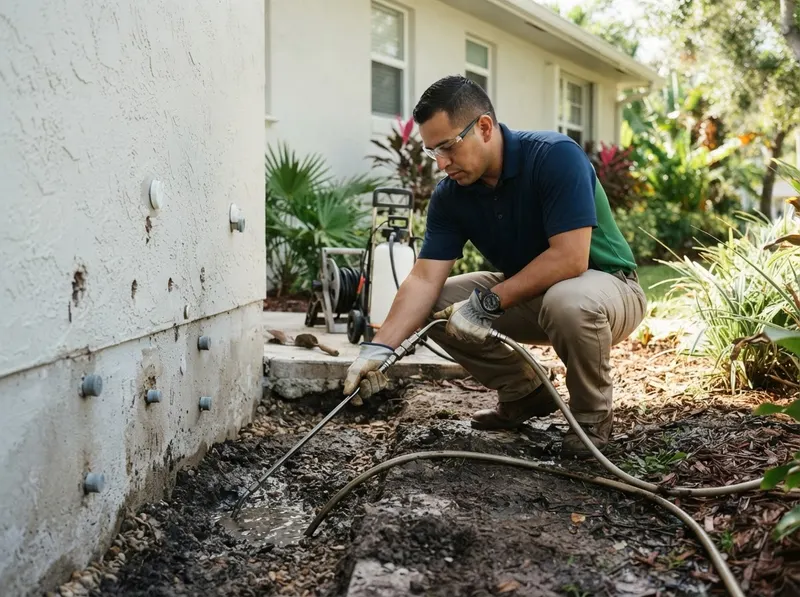
Installation follows four defined technical stages. First, technicians excavate a continuous 6-inch by 6-inch trench immediately adjacent to the exterior foundation wall, conforming to technical label directions audited by the Florida Department of Agriculture and Consumer Services. Second, technicians pump non-repellent termiticide into the trench at a regulated rate of 4 gallons per 10 linear feet per foot of depth, utilizing pressurized subterranean injection rods calibrated under standards maintained by the Occupational Safety and Health Administration. Third, where paved patios or driveways touch exterior walls near Wynwood or Upper Eastside residences, technicians drill 1/2-inch vertical ports every 12 inches to inject the emulsion into underlying soil before sealing each opening with exterior-grade hydraulic cement verified via the ASTM International masonry specifications. Fourth, backfilled soil is mixed with the termiticide emulsion to create an impenetrable barrier that repels water wash-off under the rainfall patterns recorded by the National Weather Service. UrbanNest Pest Care conducts all operations with clinical precision, safeguarding your structural foundation without internal chemical intrusion.
Subterranean Termite Soil Barriers cost in Miami

Targeted foundation spot treatment / initial minimum$250 - $450
Townhome or semi-detached perimeter barrier (100-140 linear ft)$950 - $1,650
Standard detached residential perimeter (150-220 linear ft)$1,400 - $2,300
Extensive residential perimeter with expansive slab drilling (230+ linear ft)$2,200 - $3,200

Every job gets a firm, written price after a free on-site visit.

Common questions

What causes subterranean termite infestations in Miami homes?
Subterranean termite infestations in Miami stem from warm, humid soil conditions, high organic matter, and persistent moisture pockets created by seasonal downpours and low-lying coastal water tables.
How long does a liquid subterranean termite soil barrier last in Miami?
A professionally applied non-repellent liquid soil barrier typically protects Miami foundations for 5 to 8 years, provided the treated perimeter trench remains undisturbed by landscaping or construction.
Do residents need to evacuate their Miami residence during soil barrier installation?
Residents do not need to leave their Miami home during an exterior soil barrier installation because all trenching, injection rodding, and chemical applications occur outside the living area.
Will soil barrier treatments harm patio landscaping or tree roots in Miami?
Soil barrier termiticides bind directly to organic soil particles right against the foundation wall, leaving adjacent landscaping, garden beds, and mature tropical root systems outside the immediate trench untouched.
How do technicians treat soil beneath attached concrete slabs in Miami?
Technicians treat soil beneath attached concrete slabs in Miami by drilling clean 1/2-inch access ports spaced 12 inches apart along the foundation wall, injecting the liquid termiticide underneath, and sealing the holes with matching structural mortar.

For standards, safe disposal, and service guidance on pest control services in Miami, FL, useful references include U.S. EPA, ENERGY STAR, U.S. Dept. of Energy, Consumer.gov, U.S. Census Bureau, and Google Maps. General consumer and small-business resources are available from USA.gov, Better Business Bureau, FTC Consumer Advice, U.S. Small Business Administration, and Ready.gov.

Get started today

Tell us about your subterranean termite soil barriers job in Miami and we'll send a clear, written quote, usually the same day.

Get your free pest control services quote, Miami

We only use your ZIP to check availability, no spam.