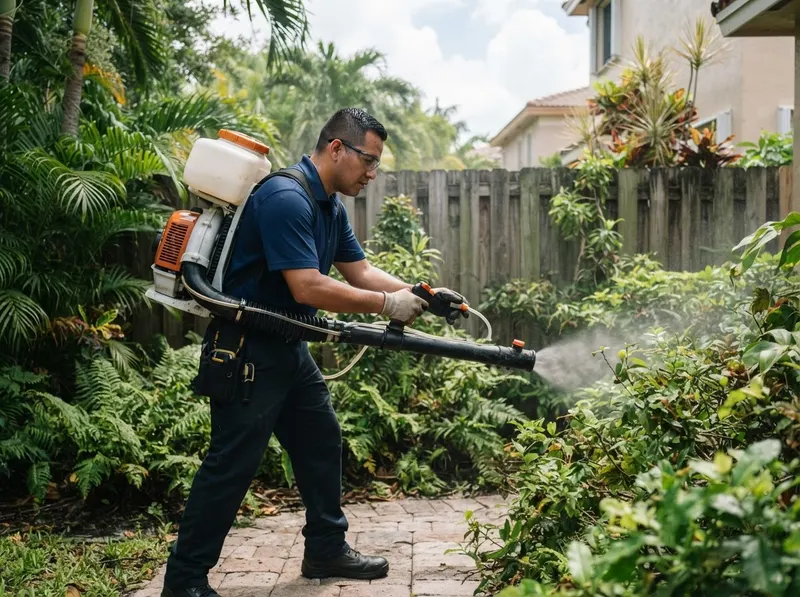
Miami-Dade County presents an intense environment for persistent insect reproduction due to year-round humidity, frequent convective rain bursts, and dense coastal microclimates. Managing vector populations around homes near Miami-Dade County Mosquito Control zones requires targeting the micro-habitats where daytime biters rest. Dense canopies in Coconut Grove and shaded courtyards along Coral Way create thermal dampening zones where container-breeding mosquitoes survive standard wind currents. By applying targeted micro-droplet applications to the undersides of broadleaf plants rather than broad-spectrum airborne fogs, UrbanNest Pest Care isolates insect harborage zones without introducing persistent airborne chemical fumes into private open-air living spaces.
Controlling mosquitoes in coastal urban corridors like Brickell and Edgewater requires structural awareness of balcony drainage, collection saucers, and decorative water fixtures. Vertical developments generate updrafts that elevate female mosquitoes directly into high-rise exterior corridors. Properties positioned near water transit channels or low-lying drainage basins along Little Havana, Wynwood, and Allapattah frequently collect runoff that bypasses municipal street treatments. In accordance with biological vector management principles documented by the United States Environmental Protection Agency, effective abatement relies on biological agents such as Bacillus thuringiensis israelensis (BTI). Introducing BTI into ornamental planters, catch basins, and bromeliad cups halts larval metamorphosis within 24 to 48 hours without disrupting domestic companion animals, beneficial pollinators, or aquatic ecosystems.
Residential landscapes bordering the urban tree canopies of Upper Eastside, Little Haiti, and Overtown demand precise property-line evaluation. If a property features heavy shade, dense ornamental landscaping, and nearby unmanaged alley easements, barrier suppression must be paired with physical sanitation. A standalone fog application offers temporary relief lasting only 48 hours because wind dispersion dilutes surface retention; conversely, integrating surface micro-encapsulated treatments on fence perimeters and dense vegetation establishes a residual protective zone lasting 21 to 30 days. The structural trade-off centers on vegetation volume: densely planted historic garden lots require systematic sub-canopy spraying to penetrate resting cover, while smaller, paved multi-family courtyards require mechanical exclusion and standing-water neutralization. Physical site dynamics are confirmed on-site prior to service commencement.